
Superior Court Release Record Role
Cook County Superior Court is a court record source, not a jail. Its clerk preserves the case documents that can explain why a person left Cook County custody. For a felony matter, those records may include a bond order, sentencing order, probation order, bench-warrant entry, bond forfeiture, sentence modification, plea, adjudication, or disposition. The sheriff's record documents the custody event, while the court file supplies the legal action behind it.
A release can occur before the case ends. Someone may post bond, receive a modified bond, have a warrant addressed, or move from confinement to probation. A sentence may be credited as time served. After sentencing, a person can be transferred to GDC rather than released to the community. Each outcome leaves a different trail, and the docket must be read in sequence.
Confirm Superior Court Release Actions
Start with the name and case number if known. Search the docket for the date near the jail exit, then identify the entry that could change custody. Statewide provider access can help locate a case, but Georgia Courts says its e-access route sends users to provider sites that require an account. Provider results should not be treated as guaranteed free or complete Cook County criminal records.
- Identify the person, approximate arrest date, charge, and Superior Court case number when available.
- Review bond orders, warrant entries, sentencing documents, probation orders, and dispositions around the release date.
- Ask the clerk for the full docket or a specific document when an online provider does not show enough detail.
- Compare the signed court action with the Sheriff's Office release date, time, reason, and transfer destination.
- Check GDC only if the sentence or sheriff record shows a move into state custody.
The Cook County released-inmate search path separates sheriff, court, GDC, parole, federal, and ICE records. Superior Court fits the path only when its case documents bear on the release. It does not maintain a live jail roster or a general list of everyone recently released.
Cook County Court Release Fields
The best document depends on the question. A docket gives the event sequence. A signed bond or sentence order gives the court's terms. A warrant entry may explain why custody began or changed, while a disposition shows the case result. Request the actual document when a short index entry is unclear.
| Court record | Release question it can answer |
|---|---|
| Bond order or modification | Was release authorized while the case remained pending? |
| Sentencing order | Did the court impose jail, prison, time served, or another sentence? |
| Probation order | Did community supervision follow confinement? |
| Bench-warrant entry | Was a warrant issued, recalled, or otherwise addressed? |
| Bond forfeiture | Did later noncompliance affect the bond record? |
| Disposition or modification | Did dismissal, plea, adjudication, or a later order alter the case? |
The court file may not state the jail's exact release time. That operational field belongs in the sheriff record. Conversely, a jail release code may not show the full wording of the judicial order. Using both sources avoids turning one short entry into a broader claim than it supports.
Superior Court Release Record Contact
The official GSCCCA Cook County clerk profile identifies the local clerk office, contact details, and weekday hours. The Cook County clerk page also confirms that the clerk handles criminal records, warrants, bench warrants, bond forfeitures, and related filings.
Cook County Clerk of Superior Court
212 N. Hutchinson Ave.
Adel, GA 31620
(229) 896-7717
Fax: (229) 896-7589
Monday through Friday
8:00 a.m. to 5:00 p.m.
Ask for the criminal docket, bond order, sentence, disposition, probation order, warrant recall, or sentence-modification document that fits the custody question. Give the case number if known and request a fee estimate before ordering a broad set of copies. Certified or complete records should come from the clerk rather than an assumption drawn from a search snippet.
The successful image manifest includes the official Cook County clerk profile shown below.
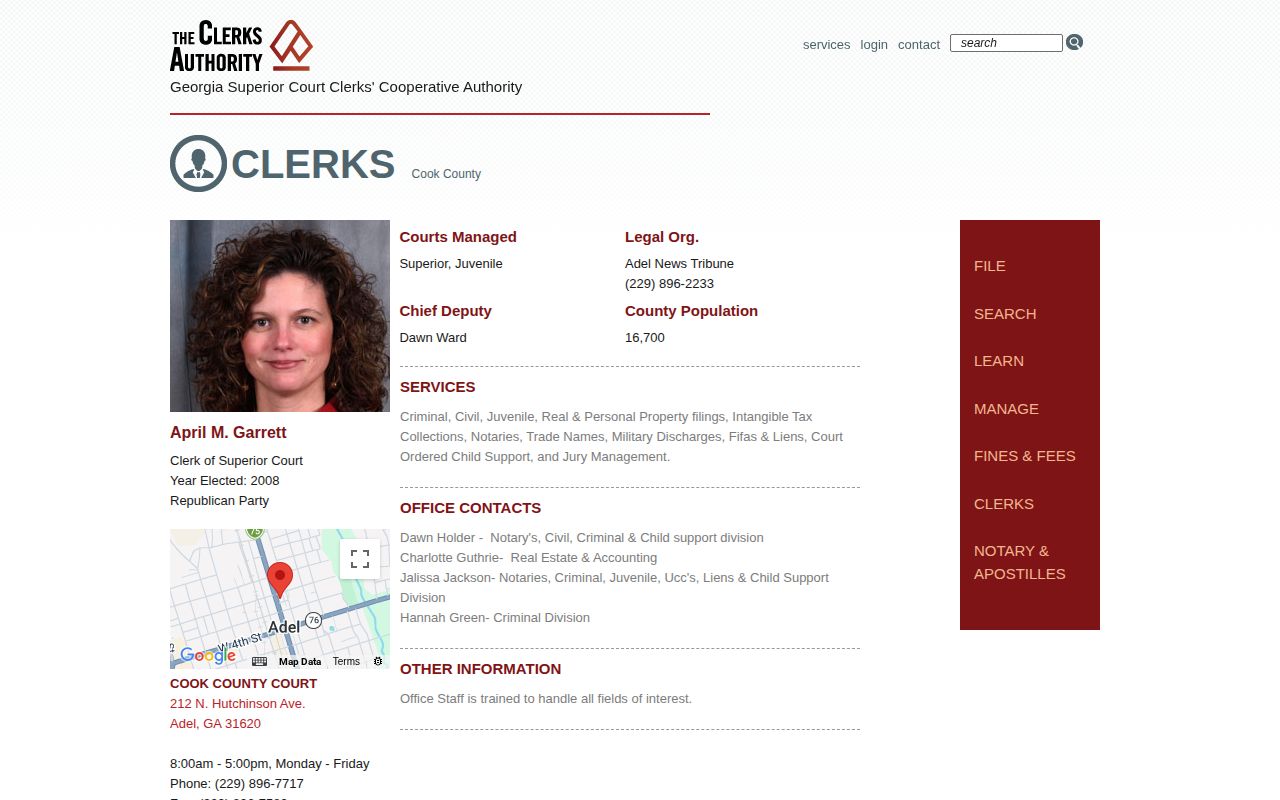
The source caption and Adel address help prevent confusion with Cook County, Illinois court results.
Superior Court Release Access Channels
Cook County court access has more than one channel. The Georgia Courts e-access page points users to provider websites and states that an account is required. PeachCourt and re:SearchGA are provider routes, but the research does not support calling either one a guaranteed free or complete public Cook County criminal database. Search access and official record access are not the same.
Use an online provider to locate a likely case or docket entry, then contact the Cook County clerk for the complete or certified document. A party-name search can miss spelling variants. A case number is more precise. When release depends on a signed bond, sentence, probation, modification, or disposition order, request that document rather than relying on a short index label.
A Georgia Open Records Act inquiry can address public administrative records, but court-record access also follows the clerk's court procedures and any legal restriction. Juvenile, sealed, restricted, or otherwise protected material may not be publicly available. Ask which record can be inspected, what copy charge applies, and whether the clerk can provide a timetable.
Cook County Bond Release Records
A bond release is a custody change, not a final judgment. Magistrate Court holds bond hearings for many early matters, while Superior Court records can contain later bond orders, modifications, criminal filings, and forfeitures. The sheriff records when the person actually leaves jail. These entries may be created at different times and should not be forced into one date.
If the person left after a recent arrest, first determine which court acted. A Magistrate Court bond event may precede a Superior Court felony file. If Superior Court later changes bond terms or records a forfeiture, that later entry does not rewrite the original jail release event. Request the relevant order from the court that issued it.
Does bond mean the charge was dismissed? No. The person may remain subject to the pending case and bond conditions after leaving jail.
Superior Court Sentence Release Outcomes
A sentencing order can lead to several paths. Time served may satisfy the confinement portion. A probation sentence can place the person in the community. A split sentence can combine confinement and later supervision. A state-prison sentence can cause transfer to GDC, which ends county jail custody without creating a community release.
For a GDC transfer, use the court sentence to establish what was ordered, the sheriff record to establish the local transfer, and GDC to establish state custody. GDC's active or inactive offender record may later show institution, sentence fields, and state release information. Superior Court does not calculate or certify a later GDC Maximum Release Date or parole decision.
Sentence completion also varies by custodian. A county jail can account for jail credit and lawful earned time; GDC maintains state sentence calculations; probation ends through its own legal process; parole discharge belongs to the parole system. “Discharged” should always be tied to the office issuing that status.
Cook County Warrants Explain Release
The Cook County clerk handles bench-warrant and criminal records, while Magistrate Court issues almost all criminal warrants. A person can leave jail after a warrant is cleared, addressed at a hearing, withdrawn, or superseded by another court action. The resulting court entry may appear before a final disposition.
Read the docket rather than guessing from absence on a jail list. Cook County publishes no official public current roster or recent-release feed identified in the research, so an empty web search cannot explain the custody change. The clerk record can show the legal event, and the sheriff can confirm the local release or transfer.
Note: A warrant entry and a release record answer related questions, but each remains a separate record held by a different custodian.
Correct Superior Court Release Records
Send a court docket, bond, sentence, warrant, or disposition error to the clerk. Send an incorrect jail release time, release reason, booking detail, hold, or transfer destination to the Sheriff's Office. State offender facts belong with GDC. This custodian split prevents a request from reaching an office that cannot amend the source record.
Georgia often uses record restriction for what may be called expungement elsewhere. A restricted, sealed, juvenile, or otherwise protected record may not appear in public results. The Georgia Open Records Act does not override those access limits. Ask the clerk whether a record can be inspected and request the legal basis when access is denied.
Keep the case number, signed order, and sheriff response together. If their dates appear inconsistent, ask each custodian about its own entry rather than treating one as proof that all other records are wrong.